TriggerBox / TriggerBox Extension

The TriggerBox helps to handle and merge triggers arriving from different sources, which is quite often a requirement in complex laboratory setups.

TriggerBox

  • TriggerBox has connectors for parallel/LPT as well as BNC inputs; the latter are all isolated from each other as well as from the other input connectors.
    It is equipped with 8 toggle switches to regulate bit-wise which input should determine the value of the output parallel port, where the EEG amplifier is connected.
  • It can provide connection to the 16th bit of the BrainAmp trigger input, via an optical fibre cable or BNC connector.
  • It offers a stretching function for the 8th and 16th bits which is useful if the incoming TTL pulses are too short for the amplifier and would otherwise go undetected.
  • It is powered by USB.
  • New as of revision 2 – TriggerBox is now even more flexible and provides a virtual serial port via USB that can be directly addressed from your stimulus presentation software.

TriggerBox Extension

  • TriggerBox Extension offers 8 additional BNC connectors which can be linked to the 8 upper bits (from lines 8 and 15) of the BrainAmp or used as a standalone solution for amplifiers such as actiCHamp or V-Amp in situations where stretching, switching and isolation functions are not required.
  • It can be connected to the output trigger port of the actiCHamp in order to lead the outgoing signal to the BNC ports.

Learn more:

SyncBox Brain Products Website

Press Release: TriggerBox 2 – millisecond precise trigger without a parallel port


Request a Quotation

SyncBox

SyncBox is a must-have solution to boost data quality for concurrent EEG and fMRI recordings

The Syncbox is a unique tool which significantly reduces timing related errors and boosts the quality of MRI artifact correction by synchronizing the clock of the BrainAmp MR / BrainAmp MR plus amplifier with the clock driving the MRI scanner’s gradient switching system.

The SyncBox is essential to recording high quality EEG data in the MR environment and is it compatible with all major commercial MRI scanners available on the market.

  • Synchronizes the clock of BrainAmp MR amplifiers with the master clock driving the MRI scanner’s gradient system
  • Significantly reduces timing related errors and boosts the quality of gradient artifact correction
  • SyncBox scanner interface and scanner clock output are physically connected (using galvanic coupling) to avoid potential influence on the MR scanner system
  • Seamless integration with BrainVision Recorder and Analyzer software by means of dedicated trigger codes and implemented algorithms

Syncbox

Reference: Mandelkow, H., Halder, P., Boesiger, P., & Brandeis, D. (2006). Synchronization facilitates removal of MRI artefacts from concurrent EEG recordings and increases usable bandwidth. Neuroimage, 32(3), 1120-1126. https://doi.org/10.1016/j.neuroimage.2006.04.231

Learn more:

SyncBox – Brain Products website

EEG-fMRI Booklet


Request a Quotation

BrainVision RecView

Software for real-time data analyses

BrainVision RecView is an advanced solution designed for real-time analysis of data received over the Ethernet network via TCP-IP directly from BrainVision Recorder.

  • Widely used in the EEG/fMRI field to remove both the gradient and the ballistocardiogram artifact (permitting experimental control during the scan).
  • The “Template Drift Compensation” algorithm remedies template jitter caused by imperfect synchronization between the EEG amplifier and the scanner clocks and thus ensures optimal data correction at any time.
  • Uses the same history tree concept already implemented in BrainVision Analyzer
  • Can also be used for FFT analysis, data filtering, mapping of the surface potentials as well as BCI and bio-/neurofeedback on the incoming data.

BrainVision RecView

Find out more


Request a Quotation

MOVE

Going Wireless has never been so easy

The wireless MOVE is a solution that replaces the existing cables connecting electrodes and amplifier with wireless-based communication. This solution allows the subject to move freely and makes it very suitable for use with a Brain Computer Interface (BCI), neurofeedback and motor learning.

MOVE at a glance

  • The small, lightweight transmitter and the receiver can be used with virtually any existing amplifier/electrode combination.
  • As the transmitter is not integrated into the cap, there is no risk of damaging it when cleaning the cap. Simply disconnect the transmitter and clean the cap the way you always have.
  • Each MOVE is capable of handling 64 channels; up to 5 units can be used in the same location.
  • Normal experiments become more convenient; new paradigms can be incorporated into day-to-day research.

How does it work?

The MOVE transmitter amplifies and digitizes the incoming raw analogue signal and sends it to the MOVE receiver, where the digital data is converted back to analogue. Since the amplification factor is 1:1, the existing EEG amplifier receives exactly the same data as previously. If the data is not received properly, the receiver unit will send a TTL pulse marker to the amplifier. A further marker is sent when stable and reliable data reception resumes. This feature is extremely useful during the data analysis stage; in the unlikely event of the wireless connection being interrupted during the recording, a user can still determine exactly when the problem occurred.

Learn more:


Request a Quotation

EasyCap SIGGI-II

Signal Generator & Impedance Meter

SIGGI II is a laboratory tool for generating and measuring electrical signal parameters in the voltage range of typical biophysiological signals.

Functions:

The calibrated Signal Generator, issuing both built-in and recorded signals onto 1-32 channels (accompanied by a trigger signal), can be used to verify an amplifier‘s ability to correctly record amplitudes and frequencies, to visualize filter characteristics, to check linearity of DC amplifiers and to check Common Mode Rejection (CMR).

The Impedance Meter measures the impedance between 1-32 electrodes and their reference and ground electrodes. Special custom adaptors for any EEG-Recording Cap / electrode input box can be supplied. This is a comfortable way to measure impedances independent from the EEG amplifier or if there are reasons to doubt the impedance measurement routines built into the respective amplifier.

The Amplifier/Data Logger can record, amplify and store user specific signals and replay them with the Signal Generator.

The Electrode Tester measures the electrode potential of 1-32 electrodes and its changes for up to 6 hours. This unique tool is indispensable for assessing the suitability of individual electrodes for DC recordings.

SIGGI-2 EasyCap connections

Find out more Product Datasheet


Request a Quotation

Consumables

We offer the complete range of caps and accessories from EASYCAP and a comprehensive range of electrodes, pastes/gels, sensors and accessories in the areas of sleep, neurophsyiology, neuroscience for clinical and research applications.

Consumables Preps Pastes

For more information check out our Comprehensive Catalogue

Request a Quotation

BrainCap

Symbiotic Devices offers a comprehensive range of caps to suit most applications. In order to reach an optimal fit, a complete range of 12 different sizes is available, choose between Asia or Caucasian Cut, as well as several colours and number of contact points.

Caps are compatible with most EEG Amplifier Systems in the market as well as TMS, MEG & MRI Compatible.

BrainCap Sizes


Layouts:

International Layout: 10/20 System Electrodes are
distance of 10% or 20% from Cz down to the hat line.

Specialized Equidistant Layout: Electrodes are equidistant to each other via trigonometry calculation.

BrainCaps

Cap Cuts:

Both cap types, Subtemporal and SubInion, are available in two cap cuts. One cap cut provides a better fit for more oval/rectangular head shapes and is commonly used worldwide (called “Caucasian cut”).
The other one is cut for rounder head shapes and typically provides a better fit for participants from countries like e.g. Korea, China, Taiwan and Japan (called “Asia Cut”).


Cap Fabrics:

All caps can be made with your choice of two different types of fabric: high-precision fabric and high-comfort fabric.

High-precision fabric is of medium elasticity and has advantages in that it provides a precise reproduction of electrode positions, a longer life span and a quick drying time.

High-comfort fabric is of higher elasticity and works with a variety of head shapes. In the majority of caps, we use the high-precision fabric for adult and juvenile cap sizes and the high-comfort fabric for baby cap sizes.

Find out more


Request a Quotation

BrainAmp Standard

The BrainAmp amplifier is a compact solution for neurophysiology research, the Amp can be used along with other units within the same product range in a great range of applications. The BrainAmp is portable and can be used for standard EEG/ERP recordings as well as other types of acquisitions including mobile applications.

BrainAMP

With a 5 kHz sampling rate per channel, the BrainAmp can be used to record EEG, EOG, EMG signals as well as evoked potentials with a frequency up to 1 kHz. The 16 bit TTL trigger input allows the detection of a large number of markers from visual, accoustic, electrical, magnetic or other stimulation modalities.

The BrainAmps can be used both with passive and active electrodes offering a great degree of flexibility and is powered by a rechargeable battery, the PowerPack.


Other products in the BrainAMP Series:

BrainAmp DC

BrainAmp ExG

BrainAmp MR

BrainAmp MR Plus


Find out more


Request a Quotation

BrainAmp ExG

BrainAMP ExG

The BrainAmp ExG amplifier is a bipolar amplifier used to record EMG, ECG, EOG and polygraphic channels such as GSR (Galvanic Skin Response), acceleration, temperature and blood pulse.

The compact BrainAmp ExG amplifier (16ch) is based on the same technology and design as the entire BrainAmp family and is therefore fully compatible with all the other members of its BrainAmp siblings.
All signals can be recorded with a sampling rate up to 5000 Hz and a broad hardware bandwidth ranging from DC to 1000 Hz. The ExG was developed as an extension to all the other BrainAmp amplifiers, however it can be used as a fully independent unit.

The ExG amplifier is powered by a rechargeable battery “the PowerPack”, and can be connected to a laptop for recordings anytime anywhere.


Other products in the BrainAMP Series:

BrainAmp Standard

BrainAmp DC

BrainAmp MR

BrainAmp MR Plus


Find out more


Request a Quotation

BrainVision Recorder 2

BrainVision Recorder 2 Software

A reimagined, reliable approach to neurophysiological data acquisition

Key Advantages

  • User-Centric Design: Streamlined workflows engineered for highly efficient data collection.

  • Unified Management: Configure your amplifier and workspace parameters from a single, centralized hub.

  • Premium Signal Quality: Built from the ground up to ensure secure, top-tier recordings.

  • Modern Integration: Features native LSL streaming capabilities and BIDS-compliant data exports.

The BrainVision Recorder 2 Software represents a major leap forward in dependable data acquisition. Specifically engineered for electrophysiological and neurophysiological signals, this cutting-edge software seamlessly integrates with Brain Products EEG amplifiers.
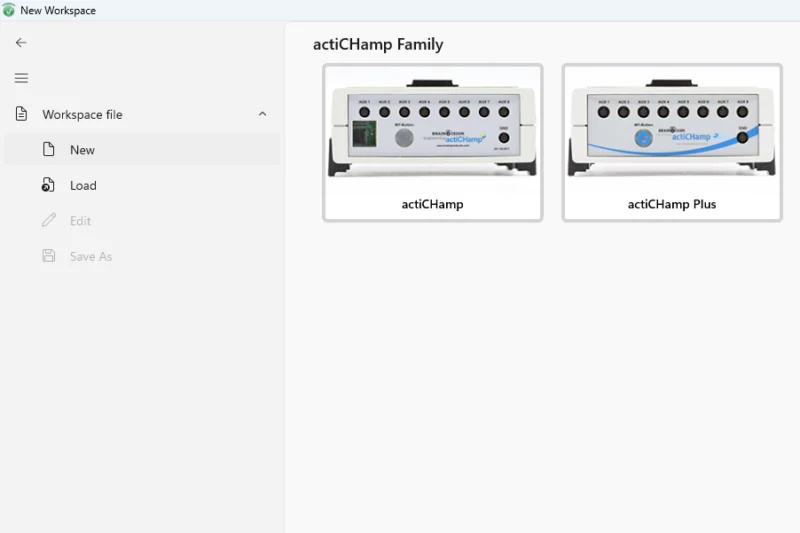
Streamlined EEG Acquisition: Intuitive Design for Precise Results

BrainVision Recorder 2 Software simplifies the complexities of EEG data collection. Boasting a modern graphical user interface (GUI), the software places critical controls and essential options exactly where you need them, ensuring a smooth and efficient user experience.

From initial hardware syncing to final signal verification, the platform guides researchers through a standardized, best-practice recording workflow:

  • Workspace Configuration: Establish and apply uniform parameter settings across all research sessions.

  • Impedance Mapping: Quickly evaluate electrode contact quality prior to launching your study.

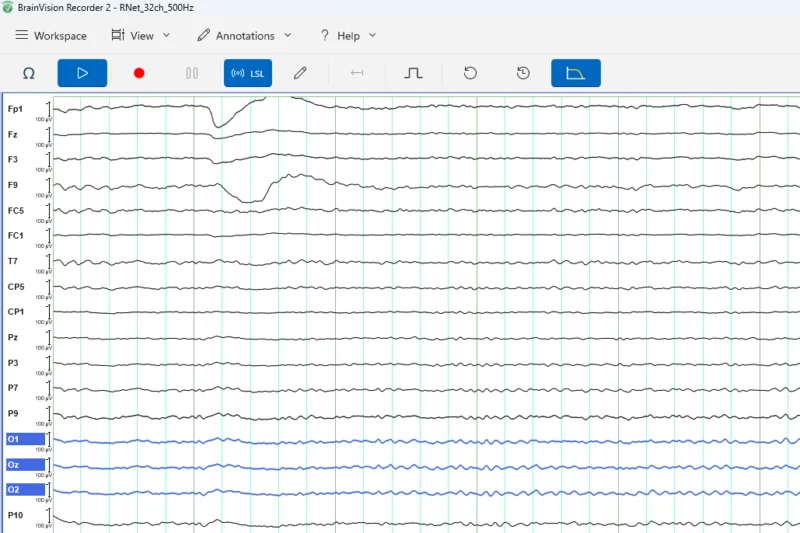
  • Live Signal Inspection: Evaluate raw data integrity in real time to ensure flawless collection.

  • Confidence-Driven Recording: Launch your EEG acquisition sessions knowing your data is secure.

While recording, users can dynamically adjust data views and monitor live EEG streams with highly flexible visualization tools:

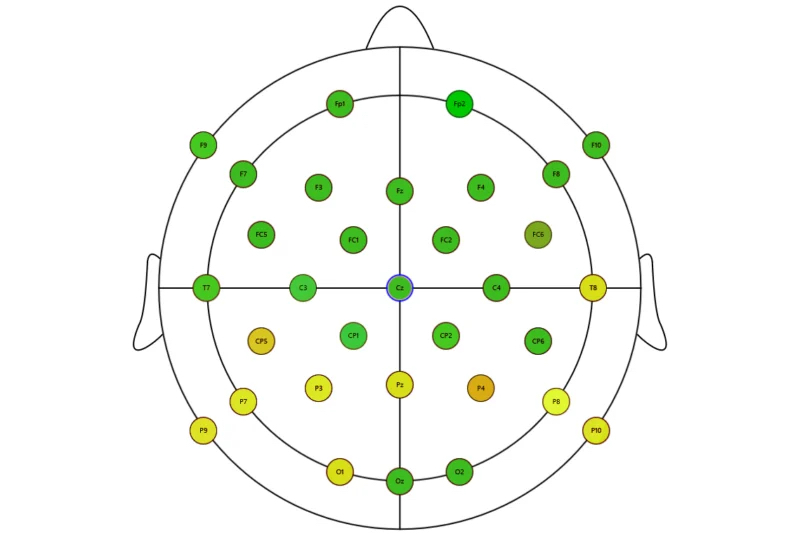
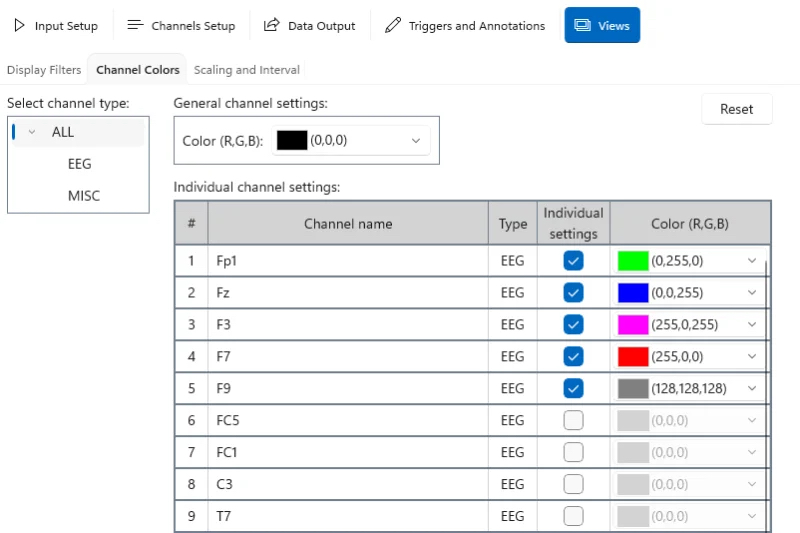
  • Personalized channel filtering, distinct color-coding, and custom scaling.

  • Rapid toggling for specific channel subsets.

  • Simultaneous side-by-side viewing of standard montages in independent windows.
Centralized Management for Peak Efficiency

Eliminate tedious setup steps with the all-in-one Workspace Editor, which consolidates your vital preparation tasks into a single interface:

  • Adjust amplifier settings and parameters.

  • Customize and map channel layouts.

  • Define precise trigger/marker rules and output formats.

  • Pre-configure preferred display layouts.

Every workspace file acts as a comprehensive log of your environmental setup, ensuring strict compliance and effortless study reproducibility. The outcome is minimized human error, quicker preparation times, and absolute transparency.
Uncompromised Data Security

Leveraging a resilient architecture powered by Microsoft Windows® process management, BrainVision Recorder 2 Software guarantees superior data stability. By combining robust software engineering with workflows that promote excellent data collection habits, your valuable research files remain fully protected.

Next-Generation Data Formats and Connectivity

The software debuts the brand-new BrainVision Recording Format (BVRF). This JSON-based architecture offers enhanced readability and houses deeper contextual metadata, while maintaining full BIDS compatibility for straightforward formatting.

Compatibility Ecosystem

  • Fully supported by Analyzer 2 (v2.3.1).

  • Ready-to-use data readers available for Python, MATLAB, and EEGLAB.

Real-Time Data Distribution

Need instantaneous streaming? BrainVision Recorder 2 Software includes single-click activation for both LSL and RDA streaming protocols, allowing for effortless integration into collaborative or multi-modal setups.

Expanded Feature Highlights

  • Export multiple impedance logs into a single, dedicated file.

  • Instantly review data using pre-set montage perspectives.

  • Includes industry-standard electrode layouts: MNE Realistic 10-05 and Easycap 10-05.

  • Out-of-the-box, pre-configured sensor layouts.

  • Enhanced, highly flexible marker configuration options.

  • Multi-color channel visualization for easier tracking.

Amplifier Compatibility & Licensing

BrainVision Recorder 2 Software currently supports actiCHamp and actiCHamp Plus hardware systems.

⚠️ Compatibility Note: Support for LiveAmp systems is coming in a future update. For the time being, BrainAmp and LiveAmp users should remain on BrainVision Recorder 1 until compatibility is officially released for those models. Please select your software license based on the current hardware utilized in your laboratory.

System requirements
Operating systems:Windows® 11
Processor: ≥ 2.5 GHz, 2 or more cores on an x64-bit compatible processor
RAM: ≥ 8 G
Graphics adapter: Compatible with DirectX 12 or later with WDDM 2.0 driver
Free disk space: > 16 GB free disk space Additional storage requirements depend on the extent of the data to be recorded.
Monitor: Full HD (1080p) or higher

Classification
Medical product: No
CE marking: No

Find out more

Request a Quotation

Axilum TMS Robotics

For automated TMS coil placement and tracking

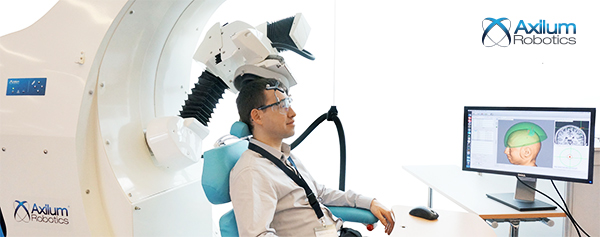
Axilum Robotics TMS-Robot is the first robot specifically designed for Transcranial Magnetic Stimulation (TMS). TMS-Cobot is the second robot developed, based on collaborative robotic technology, i.e. robots designed to work « with » humans.
The automated procedure, with the permanent control of the position, the orientation and the contact of the stimulation coil on the head, offers many advantages including accuracy, repeatability of TMS sessions, operator and patient safety and comfort.
Axilum Robotics offers different robotic solutions for TMS, adapted to various needs, from research to therapeutics.

Axilum-Robotic-TMS

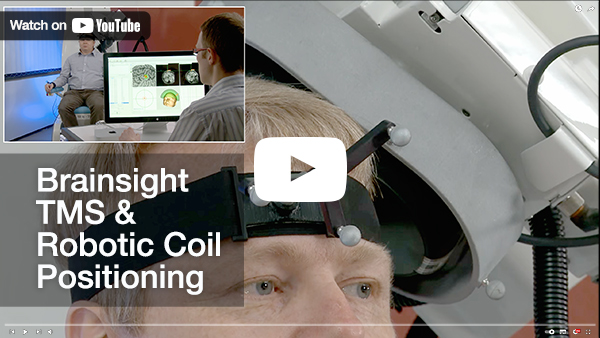
Demonstration of the Axilum Robotic Coil used with Brainsight TMS

Brainsight-TMS-&-axilum-video


Request a Quotation

BrainAmp MR Plus

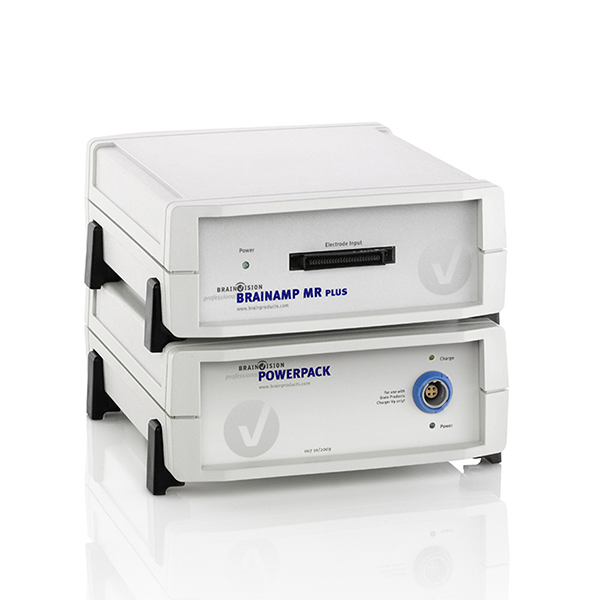
BrainAmp MR PlusThe BrainAmp MR plus enhances the already outstanding features of the BrainAmp MR. It offers both AC to DC mode acquisitions as well as extends the hardware bandwidth.
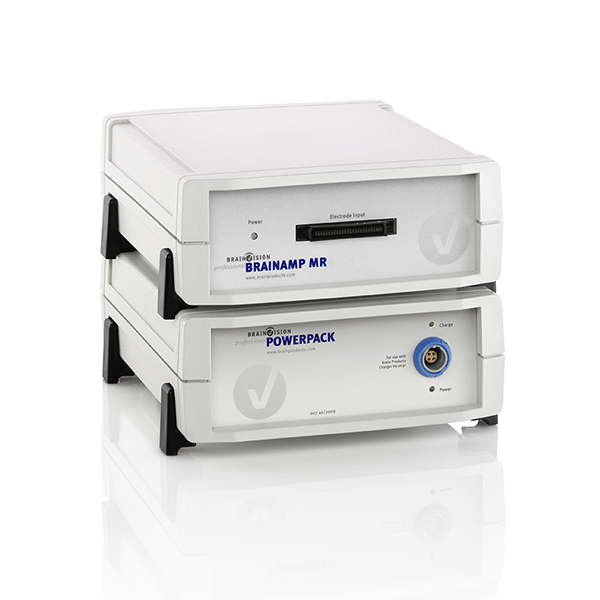
The BrainAmp MR Plus can be placed inside of the MRI chamber to achieve simultaneous EEG/fMRI acquisitions as well as used in the EEG lab for EEG/TMS co-registrations, EEG/ERP studies and Brain Computer Interface applications. There is no need for different amplifier types it offers a solution for many applications.

The BrainAmp MR plus is  part of the compact and modular consisting of 32 channels, which can be combined and stacked up one on one to acquire up to 256 EEG channels. The BrainAmp MR system is powered by the rechargeable battery PowerPack, and can be used in many environments, even for outdoor recordings. The BrainAmp MR plus system can be combined with the BrainAmp ExG MR amplifier to record EEG, EOG, EMG, ECG, GSR (Galvanic Skin Response) and many other types of bipolar and auxiliary signals.


Other products in the BrainAMP Series:

BrainAmp Standard

BrainAmp DC

BrainAmp EXG

BrainAmp MR


Find out more


Request a Quotation

BrainAmp MR

BrainAMP MR

The BrainAmp MR is a proven solution for simultaneous EEG/fMRI acquisitions.

The BrainAmp MR is a compact, modular MR compatible EEG amplifier consisting of 32 unipolar channels. Each 32 channel unit can be stacked to expand the number of channels up to 256 and combined with the BrainAmp ExG MR amplifier to record EEG, EOG, EMG, ECG, GSR (Galvanic Skin Response) and many other types of bipolar and auxiliary signals.The BrainAmp MR system is powered by the rechargeable battery PowerPack, and can be used for many applications including the EEG lab for EEG/TMS co-registrations, EEG/ERP studies and Brain Computer Interface applications.

The BrainAmp MR can be placed directly inside the MRI chamber and placed right behind the subject’s head. The signal from the amplifier is then sent via optic cable to the USB interface located in the control room.  This reduces the length of electrical connections and minimizes MR gradient artifacts and RF signal induction.  The short length required for the electrical cables used to connect the electrode cap with the amplifier complies with all safety requirements for the experimental subject and reduces the chance for cable movement artifacts.


Other products in the BrainAMP Series:

BrainAmp Standard

BrainAmp DC

BrainAmp EXG

BrainAmp MR Plus


Find out more


Request a Quotation

BrainAmp DC

BrainAMP DC

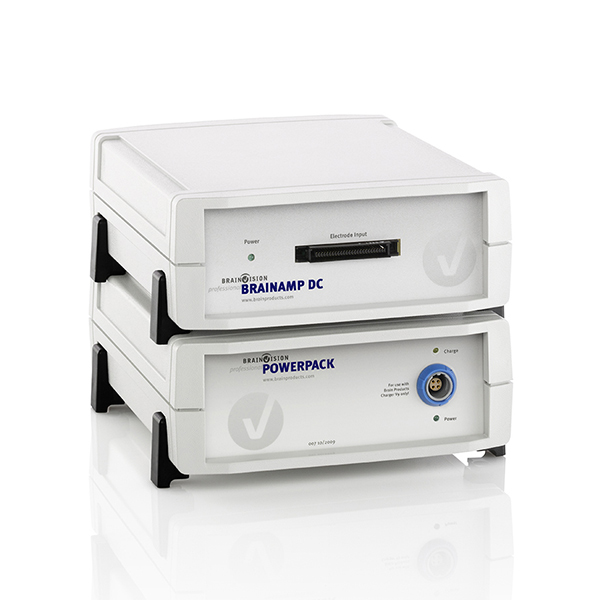
Designed for neurophysiology research and used in neurophysiological research and the clinical world. The BrainAmp DC can be used for a great range of applications, ranging from standard EEG/ERP recordings to simultaneous EEG/TMS and EEG/MEG acquisitions, Brain Computer Interface and Neurofeedback.

The BrainAmp DC includes all the great features of the BrainAmp amplifier plus the addition of the DC recording mode as well as with multiple hardware filtering options. The amplifier is fully controllable via the recording software. It is also possible to switch from DC to AC recording mode as well as to select different hardware bandwidths within the software. The BrainAmp DC is a fully portable amplifier which connects to any laptop and is powered by a rechargeable battery, the PowerPack.


Other products in the BrainAMP Series:

BrainAmp Standard

BrainAmp EXG

BrainAmp MR

BrainAmp MR Plus


Find out more


Request a Quotation

CED 1902 Amplifier

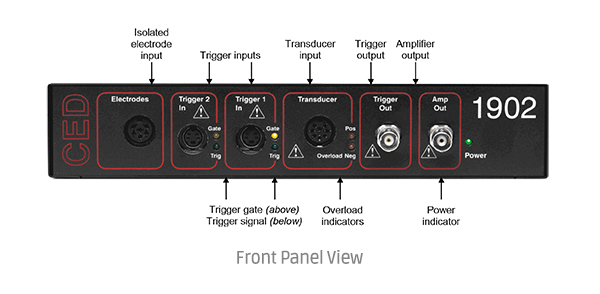
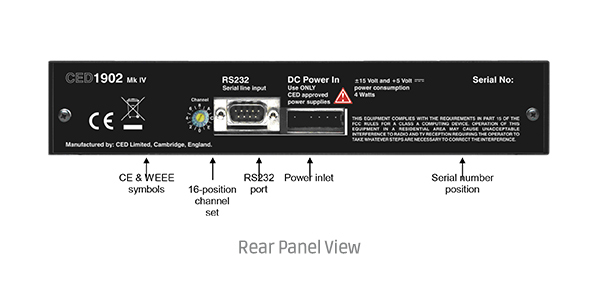
The 1902 is a versatile modular unit designed to work with modern computer-controlled data acquisition systems. Developed for a broad range of applications, the 1902 accepts biological and instrumentation signals from a wide variety of sources.

It is available in single or multi channel configurations. Communication with the computer is achieved through a serial line, allowing multiple sets of units to be controlled simultaneously.

Software controllable features

  • Programmable gain with readback
  • Dynamically controlled 12-bit offset
  • AC/DC coupling
  • Selectable high and low pass filter settings
  • Selectable mains notch filter
  • Optional input clamping

1902 Amplifier Front CED

1902 Amplifier rear CED

A major advantage of programmable amplifiers is the degree of interaction between the signal conditioner and the application software recording the data. The 1902 is directly controlled through the CED data acquisition and analysis programs Spike2 and Signal, or through a stand-alone control application.

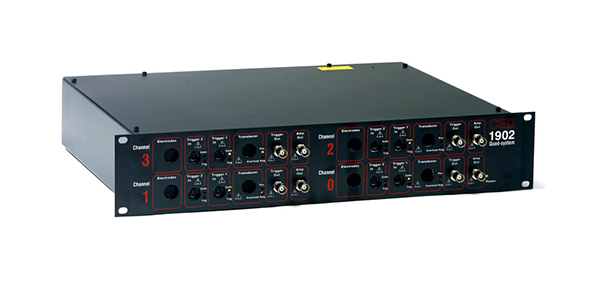
1902 Amplifier quad CED

Each 1902 is a single channel modular unit, but they can be combined into
stacks to give multiple channels or supplied as dual or quad channel variants
with optional rack-mounting. Multiple stacks, dual or quad channel units can
then be ‘daisy-chained’ together to give the number of channels required.

Find out more


Request a Quotation